Plan the Next Charge
Driving an electric vehicle across Norway's mountains is remarkably straightforward once you separate flat-road range estimates from vertical elevation physics. While a mid-size EV might consume 16 kWh/100 km along a fjord shoreline, climbing 1,300 vertical metres over 25 kilometres can briefly push consumption above 38 kWh/100 km.
The reassuring counterbalance occurs on the descent: regeneration frequently restores 4% to 8% state of charge before you reach the next fjord floor.
Major Norwegian Charging Operators & Access
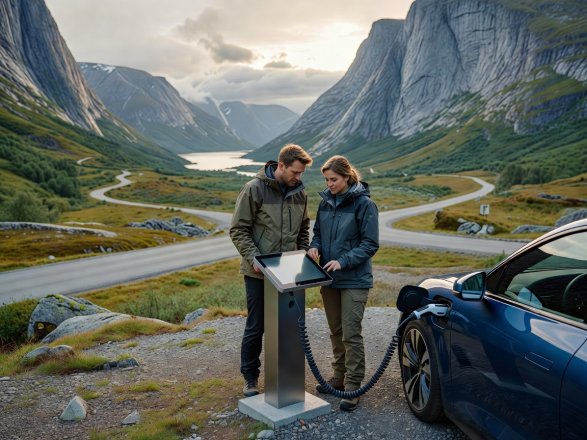
High-power CCS2 DC chargers (150 kW to 300 kW) are positioned at key valley junctions below every major mountain plateau. Recent regulatory standards have expanded contactless bank-card tap terminals on newer stalls, while roaming apps and RFID tags remain useful on older 50 kW units.
| Network Operator | Key Mountain Gateway Hubs | Connector Standards | Payment & Access Options |
|---|---|---|---|
| Mer Norway | Lom, Gol, Dombås, Beitostølen, Vossevangen | CCS2 (50–300 kW), Type 2 AC | Contactless payment card on newer stalls, Mer Connect app, Elton roaming app. |
| Eviny (Bilkraft) | Lærdal, Aurland, Eidfjord, Stryn, Sogndal, Røldal | CCS2 (150–360 kW), Type 2 AC | Tap-to-pay bank cards on fast hubs, Bilkraft app, major European roaming cards. |
| Recharge | Otta, Geilo, Oppdal, Ringebu, Åndalsnes | CCS2 (150–300 kW) | Contactless card terminals, Elton app, Fortum Charge & Drive, Plugsurfing. |
| Circle K & Uno-X | Lillehammer, Fagernes, Haukeli, Berkåk | CCS2 (150–300 kW) | Direct credit/debit card tap at dispenser (similar to fuel pumps) or station apps. |
| Tesla Supercharger (Open to non-Tesla CCS) |
Byrkjelo, Lom, Gol, Røldal, Eidfjord, Dombås, Nebbenes | CCS2 (150–250 kW) | Tesla smartphone app (select "Charge Your Non-Tesla") or V4 stall card reader. |
The Valley-Before-Summit Rule
Never begin a mountain pass climb with less than 35% state of charge in summer or 50% in cold weather, even if the total distance to the far side is only 60 kilometres. Rapid elevation gain lowers predicted range aggressively on the dashboard computer during the first half of the climb, which can trigger unnecessary range anxiety at the summit plateau.
-
Pre-Condition Battery Before Valley Hubs
Select the DC charging station in your vehicle's built-in navigation so the battery pack warms to optimal charging temperature before you arrive in towns like Lom or Eidfjord.
-
Avoid Charging to 100% at High Altitude
If you charge at a high plateau hotel (such as Geilo or Beitostølen), cap your charge at 85–90% so the battery can absorb regenerative braking energy on your morning descent.